
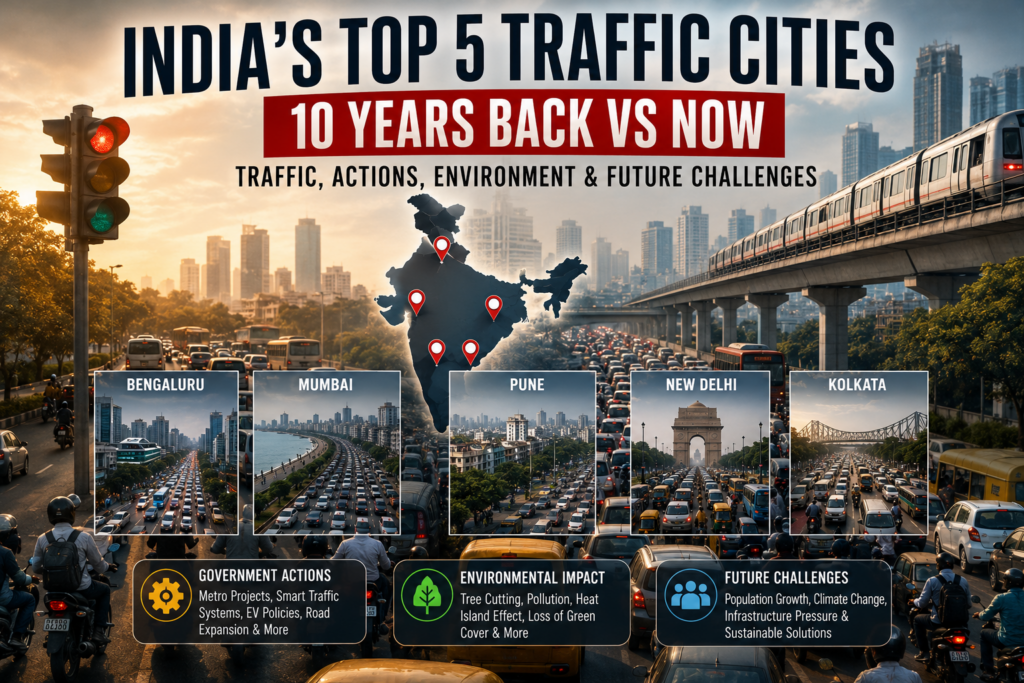
Discover how Bengaluru, Mumbai, Pune, New Delhi, and Kolkata have changed over the last 10 years. Explore the top Traffic-Congested Cities in India, their traffic growth, government actions, environmental impact, and future challenges.
Top 5 Most Traffic-Congested Cities in India: Past, Present, Government Actions, and Future Challenges
India’s cities are growing very fast. More people are moving to cities for jobs, education, and better opportunities. Because of this, the number of vehicles on roads has increased every year.
Ten years ago, traffic was a problem in some areas. Today, traffic has become a daily challenge in many major cities. People spend hours on roads, fuel is wasted, pollution increases, and stress levels rise.
In this article, we will look at the top five traffic cities in India:
- Bengaluru
- Mumbai
- Pune
- New Delhi
- Kolkata
We will compare how traffic was 10 years ago, what the situation is today, what governments have done, environmental impacts, and what the future may look like.
1. Bengaluru – India’s Traffic Capital and one of the the Congested city
Imagine waking up at 7:00 in the morning for work. Your office is only 12 kilometers away. You think you’ll reach in about 30 minutes. Instead, you spend nearly two hours sitting in traffic. Cars barely move. Bikes squeeze through tiny gaps. Buses stop every few minutes. The air is filled with the sound of horns. if you’re suffering from traffic every day, this frustrating experience has likely become a part of your daily routine.
For many people in Bengaluru, this is not a one-day problem. It has become a part of everyday life, with thousands of commuters suffering from traffic every day. Long travel times, frequent traffic jams, and heavy congestion have turned daily commuting into a stressful experience.
Bengaluru, once known as the “Garden City of India,” is now widely recognized for its traffic congestion. As India’s technology capital, the city is home to thousands of IT companies, startups, and global businesses. Every year, lakhs of people move here in search of better jobs and career opportunities. While the city’s population and number of vehicles have increased rapidly, the road infrastructure has struggled to keep pace, leading to severe traffic problems across many areas.
Today, Bengaluru traffic is one of the biggest challenges faced by residents and visitors alike. Daily road congestion affects office commuters, students, businesses, emergency services, and public transport. Besides wasting valuable time, heavy traffic congestion in Bengaluru also increases fuel consumption, air pollution, and stress levels, reducing the overall quality of life.
In this article, we’ll explore how Bengaluru’s traffic congestion reached its current level, the major causes behind the city’s growing traffic problems, the steps the government is taking to improve the situation, whether these initiatives are making a difference, and what the future of urban mobility in Bengaluru might look like..
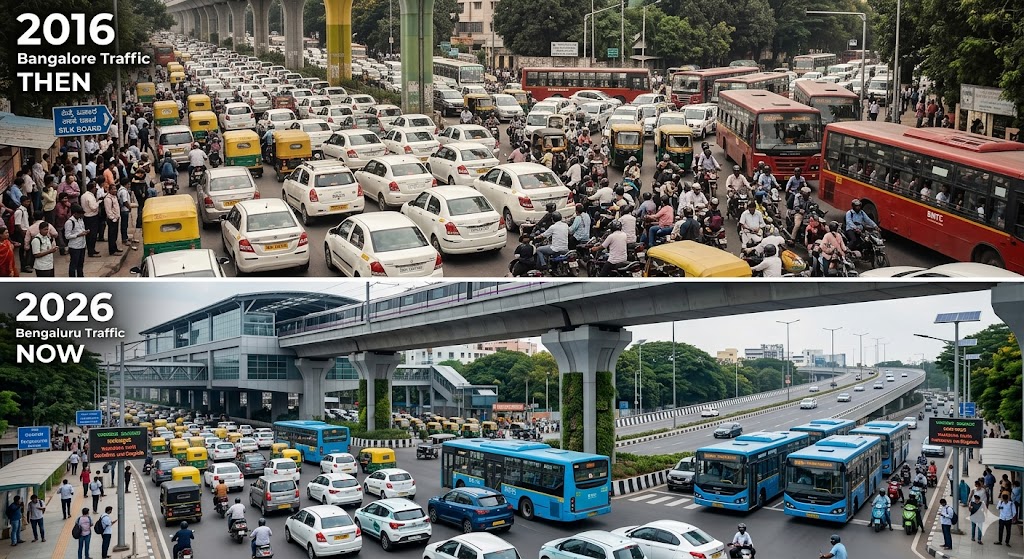
Traffic Situation 10 Years Ago
If you had visited Bengaluru about ten years ago, traffic congestion was already a concern, but it was very different from what people experience today. Although Bengaluru was already considered one of the traffic jam cities in India, the overall traffic situation was more manageable, and daily commuting was less stressful than it is now.
People often complained about traffic jams during office hours, especially around Electronic City, Silk Board Junction, Marathahalli, Whitefield, KR Puram, Hebbal, and Outer Ring Road. These areas regularly experienced peak-hour traffic due to the growing number of IT employees and office commuters. However, outside rush hours, road congestion was relatively low, traffic flowed more smoothly, and many roads became free for easier travel.
Back then:
Fewer private vehicles were on the roads.
Metro connectivity covered only a limited part of the city.
IT companies were growing rapidly, but many new residential areas were still developing.
The city’s population was much smaller than today.
Ride-hailing services were still expanding.
Many families owned just one vehicle.
Most office employees spent around 30 to 60 minutes travelling one way. Long traffic jams happened mainly during morning and evening rush hours. Even then, Bengaluru was steadily moving toward becoming one of the High Traffic Cities in India due to rapid urbanization and population growth.
Although people complained, many still believed Bengaluru’s traffic could be fixed with better roads and more public transport.
Why Bengaluru Is One of the Top Traffic-Congested Cities in India
The traffic problem did not appear overnight. It grew slowly over many years.
1. Bengaluru Became India’s IT Capital
Global technology companies opened large offices across the city.
Thousands of professionals arrived every month from different parts of India.
More people meant:
More homes
More offices
More schools
More shopping malls
More vehicles
The city’s growth happened much faster than its road network.
2.The Number of Vehicles Increased Rapidly
One of the biggest reasons behind Bengaluru’s traffic is the huge increase in private vehicles.
Many families now own:
Two-wheelers
One or two cars
Office vehicles
With millions of registered vehicles using the same roads every day, congestion became unavoidable. The growth in vehicle ownership has consistently outpaced road expansion.
3.Narrow Roads in Old Areas
Many parts of Bengaluru were designed decades ago.
At that time, city planners never imagined today’s population or vehicle numbers.
As a result:
Roads are narrow.
Junctions become crowded quickly.
There is very little space to widen roads in older neighbourhoods.
Even when authorities want to improve roads, nearby buildings leave little room for expansion.
4.Growth Happened in Every Direction
Earlier, most business activity was concentrated in the city centre.
Today, major employment hubs include:
Whitefield
Electronic City
Manyata Tech Park
Outer Ring Road
Bellandur
Sarjapur Road
Hebbal
Every morning, lakhs of employees travel toward these areas at almost the same time, creating enormous pressure on a limited road network.
5. Public Transport Could Not Keep Up
Bengaluru has buses and Metro services, but the city’s expansion happened faster than public transport could expand.
Many newly developed areas had no Metro service for years.
As a result, people depended on:
Personal bikes
Cars
Cabs
This increased the number of vehicles on the roads every single day
Bengaluru Traffic Today
Today, Bengaluru is often listed among the world’s most Busiest Traffic Cities in India.
For many residents:
A journey of 10 km can take 45 minutes to over an hour during peak times.
Travelling across the city may take two to three hours on busy days.
Heavy rain can make traffic significantly worse because waterlogging affects several roads.
Traffic congestion is especially common around:
Silk Board Junction
Marathahalli
KR Puram
Hebbal
Whitefield
Bellandur
Outer Ring Road
Electronic City
These locations handle a huge mix of office traffic, buses, trucks, delivery vehicles, and private cars every day.
How Traffic Affects Daily Life
Traffic is much more than an inconvenience.
It affects almost every part of daily life.
People Spend Less Time with Family
Many workers leave home before sunrise and return late at night.
Instead of spending time with family, children, or friends, they spend hours inside vehicles.
Businesses Lose Productivity
Employees arrive late.
Deliveries are delayed.
Meetings get postponed.
Companies lose valuable working hours because people remain stuck on the road.
Fuel Costs Increase
When vehicles stay idle in traffic:
Fuel keeps burning.
People spend more money.
The country also loses valuable fuel resources.
Stress Levels Rise
Driving in heavy traffic every day causes:
Mental stress
Fatigue
Frustration
Road rage
Many commuters say that traffic is one of the most stressful parts of living in Bengaluru.
Air Pollution Increases
Vehicles release harmful emissions even when they are moving very slowly or standing still in heavy traffic. During long traffic jams, engines continue to burn fuel, increasing vehicle emissions, exhaust fumes, and traffic-related air pollution across the city.
This leads to poor air quality, higher levels of PM2.5 and other harmful pollutants, and poses serious public health risks, especially for children, older adults, and people with respiratory conditions such as asthma. As traffic congestion continues to grow, its impact on both the environment and people’s health becomes more significant.
Traffic in Bengaluru did not become severe because of one single mistake. It is the result of rapid population growth, booming economic development, increasing vehicle ownership, and road infrastructure that has struggled to keep pace with the city’s expansion. Recognising these challenges, the Karnataka government has accelerated major infrastructure projects, including new Metro corridors, tunnel roads, elevated roads, and smart traffic management systems to improve urban mobility and reduce road congestion. Recent developments also include the Blue Line Metro toward the airport, new tunnel projects around Hebbal, and safer cycling infrastructure in selected corridors, all aimed at reducing traffic congestion, lowering vehicle emissions, and improving air quality in Bengaluru.
What Is the Karnataka Government Doing to Solve Bengaluru’s Traffic Problem?
Traffic does not disappear overnight. Building a better transport system takes years of planning, huge investments, and cooperation from many government departments.
Over the last few years, the Karnataka Government has started several major infrastructure projects to reduce traffic congestion. Some projects are already helping commuters, while others are still under construction.
Let’s understand these projects in simple words.
1. Namma Metro Expansion – The Biggest Hope for Bengaluru
If you ask most Bengaluru residents what can truly reduce traffic, many will say one thing—Namma Metro.
The Metro is one of the fastest and most reliable ways to travel because it runs above or below the city’s crowded roads. It allows people to avoid traffic signals, jams, and long waiting times.
A few years ago, the Metro network covered only selected parts of Bengaluru. Many important IT areas had no Metro connectivity, forcing people to travel by car, bike, or cab.
Today, the government is expanding the network through multiple phases.
Some of the major expansion works include:
Metro connectivity to Whitefield
Blue Line connecting the Outer Ring Road to Kempegowda International Airport
yellow line connecting RV Road to Bommasandhra
Green Line connecting Madhavara to Silk institutes
New stations serving major residential and commercial areas
Future Phase 3 corridors covering additional parts of the city
These projects aim to connect technology parks, business centres, residential neighbourhoods, and the airport with a faster public transport system. Experts believe the Metro will become one of the most effective long-term solutions for reducing road congestion.
How Will the Metro Help?
Imagine 1,000 office employees driving separate cars to work.
Now imagine those same people travelling together on a Metro train.
Instead of hundreds of cars occupying road space, one train can carry a large number of passengers at the same time.
This means:
Fewer private vehicles
Less fuel consumption
Lower pollution
Faster travel
Reduced pressure on busy roads
Although Metro construction temporarily causes traffic because of road barricades, the long-term goal is to improve city-wide mobility.
2. Flyovers and Elevated Corridors
Another major step taken by the government is the construction of new flyovers and elevated roads.
A flyover allows vehicles to cross busy junctions without stopping at traffic signals.
Some important projects include:
Central Silk Board double-decker flyover
New elevated corridors on major highways
Signal-free road projects
Junction improvements
The idea is simple.
Instead of every vehicle waiting at a traffic signal, some traffic can move above the junction, reducing delays.
The Karnataka Government has also approved plans for multiple new signal-free elevated corridors across the city to improve traffic flow on major roads.
3.Peripheral Ring Road (PRR)
One major reason for Bengaluru’s traffic is that many heavy vehicles pass through the city even when they do not need to.
The Peripheral Ring Road project aims to solve this problem.
Instead of entering the city, trucks and long-distance vehicles can travel around Bengaluru using a ring road.
This will:
Reduce congestion inside the city
Improve travel time
Reduce pressure on residential roads
Make highways more efficient
Although the project has faced delays over land acquisition and planning, it remains one of the city’s most important long-term transport projects.
4.Suburban Rail Project
Not everyone travelling to Bengaluru actually lives inside the city.
Every day, thousands of people travel from nearby towns for work.
Most currently depend on cars, buses, or two-wheelers.
The Suburban Rail project is designed to connect Bengaluru with surrounding areas using fast commuter trains.
If successful, it could:
Reduce daily road traffic
Save travel time
Lower fuel use
Encourage people to choose trains over private vehicles
5.Smarter Traffic Signals
Traffic police are also using technology to improve traffic movement.
Many important junctions now use:
Smart traffic signals
CCTV cameras
Traffic monitoring systems
Automatic signal timing
Real-time traffic management
Instead of keeping every signal on the same timer, some signals can adjust according to traffic volume.
For example:
If one road has very heavy traffic and another road has only a few vehicles, the signal timing can change automatically to reduce waiting time.
Although this cannot eliminate congestion completely, it helps improve traffic flow at busy intersections.
6.Better Bus Services
The Bengaluru Metropolitan Transport Corporation (BMTC) continues to expand bus services across the city.
The government has introduced:
More electric buses
Additional routes
Better connectivity to Metro stations
Improved public transport integration
When buses become more comfortable and reliable, more people are willing to leave their private vehicles at home
7.Tunnel Road Project – A Big Debate
One of the most talked-about projects in Bengaluru is the proposed tunnel road connecting major traffic corridors.
Supporters believe the tunnel could reduce travel time for people driving across the city by allowing traffic to bypass busy surface roads.it is one of the top Traffic Jam Cities in India and to control the traffic govt has taken many projects.
However, many transport experts and environmental groups have raised important questions.
Some argue that:
It mainly benefits private cars.
The same investment could improve Metro and bus services for many more people.
Building more roads may encourage even more cars, bringing congestion back over time.
The project has therefore become one of the city’s most debated transport proposals.
What Will Happen If Bengaluru Continues to Ignore the Environment?
Building better roads and improving transport is important. Every growing city needs new infrastructure. But there is one important question we must ask:
Can we solve traffic problems by building more roads alone?
Many environmental experts believe the answer is No.
If development happens without protecting nature, Bengaluru could face even bigger problems in the coming years.
Let’s understand why.
1. Fewer Trees Mean Higher Temperatures
Bengaluru was once called the “Garden City of India.”
Years ago, the city had:
Thousands of large trees
Beautiful parks
Clean lakes
Pleasant weather
These trees were not just beautiful. They helped keep the city cool.
Trees:
Give shade
Reduce heat
Absorb carbon dioxide
Release oxygen
Improve air quality
When trees are cut down for road widening, flyovers, or other projects, the city loses these natural benefits.
As a result:
Roads become hotter.
Buildings absorb more heat.
People feel uncomfortable even during short walks.
Air conditioners are used more often, increasing electricity demand.
This is known as the Urban Heat Island Effect, where cities become much hotter than nearby rural areas because of concrete, asphalt, and reduced greenery.
2. Air Pollution Could Become Worse
Every day, millions of vehicles travel on Bengaluru’s roads.
Each vehicle releases harmful gases.
When traffic moves slowly, engines continue running while vehicles remain almost stationary.
This leads to:
More smoke
More fuel consumption
More pollution
Children, elderly people, and those with breathing problems are especially affected.
Long-term exposure to polluted air can increase the risk of respiratory illnesses and reduce overall quality of life.
3. Flooding May Increase
Many people think traffic and floods are unrelated.
In reality, they are closely connected.
Over the years, Bengaluru has expanded rapidly.
Some natural drainage channels and lake systems have been reduced or altered because of urban development.
When heavy rain falls:
Water cannot flow away quickly.
Roads become flooded.
Vehicles move slowly.
Traffic jams become much worse.
Many residents have experienced situations where a short rain shower causes hours of congestion.
Protecting lakes, wetlands, and drainage systems is therefore not only an environmental issue—it is also a traffic issue.
4. Loss of Wildlife
Even inside a busy city, trees and green spaces provide homes for birds, butterflies, squirrels, and many other small animals.
When these habitats disappear:
Bird populations decrease.
Biodiversity is reduced.
The natural balance of the ecosystem is affected.
A healthy city is not only one with wide roads—it is also one where people and nature can live together.
5. Water Problems
Trees play an important role in helping rainwater enter the ground.
If more land is covered with concrete:
Less water is absorbed.
Groundwater levels may fall.
Water shortages can become more common during dry seasons.
This is another reason why protecting green spaces is important for Bengaluru’s future.
Will Building More Roads Solve Traffic Forever?
At first, building a new road or flyover often reduces traffic.
People enjoy faster travel for a while.
However, something interesting usually happens.
As travel becomes easier:
More people buy cars.
More people choose to drive.
New buildings and offices appear nearby.
Gradually, the new road also becomes crowded.
Transport planners call this induced demand—when increasing road capacity encourages more driving, eventually filling the extra space again.
This is why many experts believe cities should improve public transport alongside road construction.
What Else Can the Government Do?
The Karnataka Government has already started important projects, but there are additional steps that could strengthen Bengaluru’s transport system.
Expand the Metro Faster
The Karnataka government has introduced metro services to reduce the traffic jam in Bengaluru. The Metro should connect more residential areas, technology parks, educational institutions, and business districts. The Metro is one of the best public transportation systems that govt has introduced to avoid getting stuck in traffic jams and reach their destinations faster.
When people have a convenient Metro station nearby, many are willing to leave their cars at home.
Improve Bus Services
Buses should be:
Comfortable
Punctual
Affordable
Frequent
Reliable buses can reduce the number of private vehicles on the road.
Encourage Walking and Cycling
Many short trips do not require a car.
If the city provides:
Safe footpaths
Dedicated cycle tracks
Better street lighting
Accessible crossings
more people may choose to walk or cycle for nearby destinations.
This also improves public health.
Better City Planning
Ffuture residential areas should be planned with:
Schools
Hospitals
Offices
Shopping centres
Parks
located closer together.
When essential services are nearby, people spend less time travelling..
Promote Work From Home Where Possible
During the COVID-19 pandemic, many companies adopted remote work.
The result was clear:
Fewer vehicles on the road.
Less pollution.
Faster travel for those who needed to commute.
Hybrid work models can continue to reduce peak-hour traffic for many office employees.
What Can Citizens Do?
Traffic is not only the government’s responsibility.
Citizens also play an important role.
Simple actions include:
Using public transport when practical.
Sharing rides with colleagues or neighbours.
Following traffic rules.
Avoiding unnecessary use of private vehicles.
Keeping vehicles well maintained.
Walking or cycling for short distances.
Respecting pedestrians and cyclists.
Small changes made by many people can create a big difference.
What Could Bengaluru Look Like in 2035?
The future depends on the choices made today.
If Current Projects Succeed
Bengaluru could become:
Better connected by Metro.
Easier to travel across.
Less dependent on private vehicles.
Cleaner and more environmentally friendly.
More attractive for businesses and tourists.
If Traffic Continues to Grow Without Sustainable Planning
The city may face:
Longer travel times.
Higher pollution.
More frequent flooding.
Greater fuel consumption.
Increased stress.
Higher living costs.
Loss of green spaces.
The future is therefore not fixed—it depends on balanced planning and responsible decisions.
Final Thoughts
Bengaluru is one of India’s most dynamic cities. and one of the top congested city in india.
It drives innovation, creates employment, and attracts talent from across the country.
But with this success comes responsibility.
Traffic is not simply about roads filled with vehicles. It affects people’s time, health, environment, economy, and overall quality of life.
The Karnataka Government has launched several major initiatives, including Metro expansion, flyovers, suburban rail, ring roads, and smart traffic systems. These projects represent important investments in the city’s future.
At the same time, protecting trees, lakes, and public spaces is equally important.
A truly successful city is not measured only by the number of roads it builds. It is measured by how well it balances economic growth, efficient transport, and environmental sustainability.
If Bengaluru can achieve this balance, it has the potential to become one of the world’s most liveable and well-connected cities.
2.Mumbai Traffic: Why It’s Among the Top Traffic-Congested Cities in India
Mumbai city is As one of the Top Traffic-Congested Cities in India, Imagine you wake up at 7:00 AM in Mumbai. Your office is just 15 kilometres away. You think you’ll reach in 40 minutes. But after leaving home, you find yourself moving slowly through crowded roads. Cars, buses, taxis, bikes, auto-rickshaws, and trucks all compete for the same space. Every traffic signal has a long queue. By the time you reach your office, almost two hours have passed.
For millions of people in Mumbai, this is not a rare experience. It is part of everyday life.
Mumbai is known as the Financial Capital of India. It is home to the country’s biggest banks, the Bombay Stock Exchange, Bollywood, major business headquarters, ports, and one of the busiest railway networks in the world. Every year, thousands of people move to Mumbai for jobs, education, and better opportunities.
But as the city has grown, so has one major challenge—traffic congestion.
Although Mumbai has one of the best public transport systems in India, including suburban trains, buses, Metro lines, and taxis, the roads are still packed with vehicles every day. Narrow roads, rapid population growth, increasing private vehicles, ongoing construction projects, and limited land make traffic one of Mumbai’s biggest problems.
Traffic affects almost every part of life. It wastes time, increases fuel costs, creates pollution, causes stress, and reduces the quality of life for millions of people.
In this article, we will explore how Mumbai’s traffic has changed over the last ten years, why it has become more challenging, what the Maharashtra Government is doing to solve it, and what the future could look like.
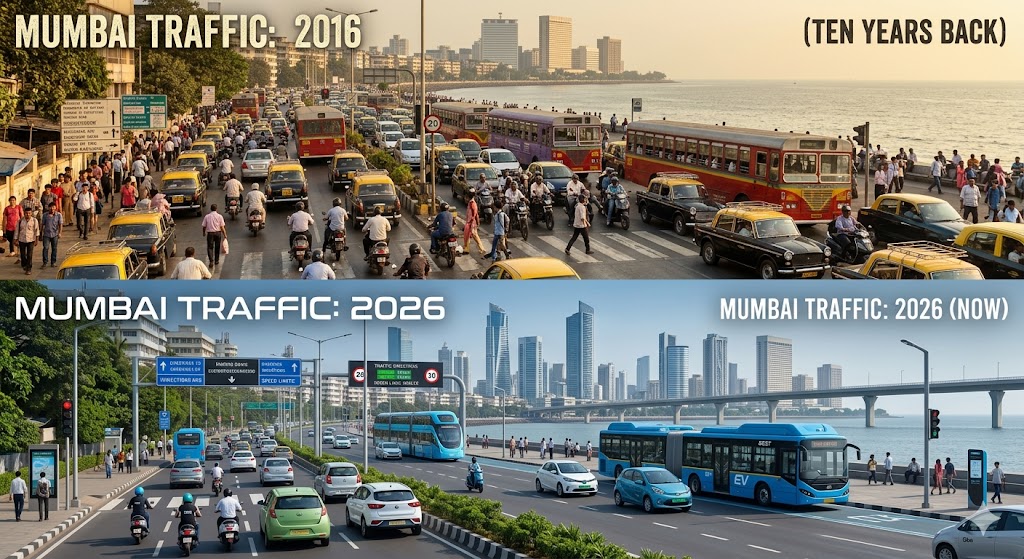
Traffic Situation 10 Years Ago
Around ten years ago, Mumbai was already known for heavy traffic. Roads like the Western Express Highway, Eastern Express Highway, Sion, Dadar, Andheri, Bandra, Kurla, and South Mumbai often experienced slow-moving traffic during office hours.
However, the situation was different from today.
At that time:
The Mumbai Metro network was very limited.
Many large infrastructure projects had not yet started.
Fewer private cars were on the roads.
Ride-hailing services were still growing.
Several suburbs were less crowded than they are today.
The city’s population was lower.
Most office workers spent around 45 minutes to one hour travelling one way. Traffic jams mainly occurred during the morning and evening rush hours.
Outside peak times, traffic usually moved more smoothly than it does today.
Even then, many people believed Mumbai needed more Metro lines, better roads, and improved public transport to handle future growth.
How Did Mumbai’s Traffic Become So Heavy?
Traffic did not become severe overnight. It increased slowly as the city expanded.
1.Rapid Population Growth
Mumbai has always attracted people from every part of India.
People move here because of:
Better job opportunities
Higher salaries
Business opportunities
Colleges and universities
Entertainment industry
Healthcare facilities
As more people arrived, the demand for homes, offices, schools, hospitals, shopping centres, and transport increased.
More people naturally meant more vehicles on the roads.
2.Increase in Private Vehicles
One of the biggest reasons for today’s mumbai is one of the top traffic congested city in india is the rapid increase in private vehicle ownership.
Earlier, many families depended mainly on trains and buses.
Today, many households own:
Two-wheelers
Cars
SUVs
Commercial vehicles
People also prefer private vehicles because they offer comfort and flexibility, especially during heavy rains or late-night travel.
3. Limited Road Space
Unlike many newer cities, Mumbai cannot easily build wide roads everywhere.
The city is surrounded by the Arabian Sea and has very limited land available for expansion.
Many roads were built decades ago when the population was much smaller.
Today, these same roads serve millions of commuters every day.
Even when authorities want to widen roads, nearby buildings, railway lines, and existing infrastructure often leave little room for expansion.
4.Commercial Capital of India
Mumbai is not just a residential city.
Every day, people travel to offices in areas such as:
Nariman Point
Bandra-Kurla Complex (BKC)
Lower Parel
Andheri
Powai
Goregaon
Worli
Thousands of employees begin and end work around the same time.
This creates enormous pressure on roads during morning and evening peak hours.
Delivery trucks, taxis, buses, and private vehicles all share the same road space.
5.Construction of Major Infrastructure Projects
Over the past several years, Mumbai has witnessed large-scale construction projects aimed at improving transport.
These include:
New Metro corridors
Coastal Road
New flyovers
Road widening projects
Bridge construction
Underground stations
While these projects are expected to improve travel in the future, construction work has temporarily reduced road space in many areas.
Barricades, diversions, and lane closures often slow down traffic before the projects are completed.
6.Dependence on Road Transport
Although Mumbai has one of India’s busiest suburban railway networks, not every destination is directly connected by train.
Many commuters still rely on:
Cars
Taxis
Auto-rickshaws
Buses
Delivery vehicles
As online shopping and food delivery services have grown rapidly, the number of commercial vehicles on the roads has also increased.
This adds even more traffic, especially during busy hours.
ours commuting.
Mumbai Traffic Today
Today, Mumbai remains one of India’s top traffic congested cities.
During peak hours:
A journey of 10–15 kilometres can easily take more than one hour.
Heavy rainfall often causes long traffic jams and waterlogging.
Important junctions become extremely crowded during office hours.
Some of the busiest traffic locations include:
Bandra
Andheri
Sion
Dadar
Kurla
Powai
BKC
Western Express Highway
Eastern Express Highway
Worli
Chembur
These areas handle thousands of private vehicles, buses, taxis, trucks, and delivery vehicles every day.
Although public transport carries millions of passengers daily, road congestion continues to be a major challenge because Mumbai’s economic activity keeps growing.
How Traffic Affects Everyday Life
Traffic is not just about waiting at a signal.
It affects people’s daily lives in many ways.
Less Family Time
Many people leave home early in the morning and return late at night.
Instead of spending time with family, they spend hours travelling.
Higher Fuel Costs
When vehicles remain stuck in traffic:
Fuel continues to burn.
People spend more money.
Businesses also face higher transport costs.
Stress and Fatigue
Driving through traffic every day can lead to:
Mental stress
Frustration
Tiredness
Road rage
Many office workers say that traffic is one of the most stressful parts of living in Mumbai.
Air Pollution
Vehicles release harmful gases even when moving slowly.
Long traffic jams increase:
Carbon dioxide emissions
Air pollution
Noise pollution
These problems affect children, elderly people, and those with breathing difficulties.
What Is the Maharashtra Government Doing to Solve Mumbai’s Traffic Problem?
Traffic cannot be solved by building one road or one bridge. A city as large as Mumbai needs many transport options working together.
As one of the Top Traffic-Congested Cities in India, Over the last few years, the Maharashtra Government has started several mega infrastructure projects to reduce traffic, improve connectivity, and make travelling easier. Some projects are already helping commuters, while others are still being completed.
Let’s understand these projects in simple words.
1. Mumbai Metro Expansion – The Biggest Hope for Mumbai
If you ask Mumbai residents what can reduce traffic in the long run, many will answer with one word—Metro.
The Mumbai Metro allows people to travel above or below the city’s crowded roads. Since Metro trains do not stop at traffic signals, passengers can reach their destinations much faster.
About ten years ago, Mumbai had only a very small Metro network. Many important business areas and residential suburbs had no Metro connectivity.
Today, the situation is changing rapidly.
Mumbai Coastal Road Project
One of Mumbai’s biggest transport projects is the Mumbai Coastal Road.
This road runs along the western coastline and is designed to reduce traffic on existing roads by providing an alternative route for motorists.
The project includes:
Modern tunnels
Sea walls
Multiple interchanges
Bridges
Dedicated lanes
Earlier, people travelling between South Mumbai and the western suburbs often had to pass through crowded city roads.
The Coastal Road gives many commuters another option, helping reduce pressure on existing routes.
Although construction caused temporary traffic diversions, the completed sections are already improving travel for many motorists.
3. Mumbai Trans Harbour Link (Atal Setu)
One of India’s biggest engineering achievements is the Mumbai Trans Harbour Link, popularly known as Atal Setu.
This sea bridge connects Mumbai with Navi Mumbai across the Arabian Sea.
Before the bridge opened, travellers often depended on longer road routes that experienced heavy congestion.
Today, Atal Setu provides:
Faster travel between Mumbai and Navi Mumbai.
Better access to upcoming business areas.
Improved connectivity to ports.
Easier travel towards Pune and other nearby regions.
The bridge not only saves time but also helps distribute traffic across different routes instead of concentrating everything inside central Mumbai.
4.Construction of New Flyovers
Busy traffic signals often create long waiting times.
To solve this problem, the government has built several new flyovers across Mumbai.
A flyover allows vehicles to cross busy intersections without stopping at signals.
Benefits include:
Smoother traffic flow.
Shorter waiting times.
Reduced fuel consumption.
Faster movement during peak hours.
Many important junctions have already become easier to cross because of these flyovers.
Although flyovers cannot completely eliminate congestion, they reduce delays at some of the city’s busiest intersections.
5.Smart Traffic Management
Technology is becoming an important weapon against traffic.
Mumbai Traffic Police now use several smart systems, including:
CCTV cameras.
Automatic Number Plate Recognition (ANPR).
Adaptive traffic signals.
Traffic monitoring centres.
Digital enforcement of traffic rules.
Some traffic signals automatically adjust their timing depending on traffic volume.
For example:
If one road has a long queue while another road has very little traffic, the signal can change automatically to reduce waiting time.
This helps improve traffic flow without building new roads.
6. Strict Parking Rules
Illegal parking blocks valuable road space.
To reduce this problem, authorities have:
- Increased parking enforcement.
- Removed illegally parked vehicles.
- Created designated parking areas.
- Introduced penalties for traffic violations.
When roads remain clear, vehicles move more smoothly.
What Will Happen If Mumbai Continues to Ignore the Environment?
Building Metro lines, roads, sea bridges, and flyovers is essential because Mumbai is one of the Top Traffic-Congested Cities in India for a fast-growing city like Mumbai. Every day, millions of people travel across the city for work, education, business, and other daily activities. Better infrastructure helps reduce travel time and supports economic growth. However, an important question remains: can Mumbai solve its traffic problem by focusing only on development while ignoring the environment?
Many environmental experts believe the answer is no.
Development and environmental protection should always go hand in hand. If the city continues to expand without protecting its trees, mangroves, wetlands, and green spaces, Mumbai may face much bigger problems in the coming years. While modern infrastructure makes transportation easier, nature plays an equally important role in keeping the city healthy, safe, and comfortable for future generations.
Rising Temperatures Due to Loss of Trees
Mumbai has never been known as a heavily forested city, but the trees that exist along roads, parks, residential areas, and open spaces play a significant role in controlling the city’s temperature. Large trees provide shade, absorb carbon dioxide, improve air quality, and make outdoor areas more comfortable.
As new roads, Metro stations, and flyovers are built, some trees have been removed to create space for construction. Although authorities often carry out compensatory plantation drives, newly planted saplings need many years before they can provide the same environmental benefits as mature trees.
If tree loss continues without proper planning, Mumbai may become even hotter in the future. Roads and buildings will absorb more heat during the day and release it slowly at night, making temperatures remain high even after sunset. This phenomenon, known as the Urban Heat Island Effect, is already affecting many large cities around the world.
Higher temperatures also increase electricity consumption because more people rely on air conditioners and cooling systems. This creates additional pressure on energy resources while increasing carbon emissions.
Mangroves: Mumbai’s Natural Protection System
One of Mumbai’s greatest natural assets is its mangrove forests. These coastal ecosystems are far more valuable than many people realise. Mangroves protect the coastline from erosion, reduce the impact of tidal waves, absorb carbon dioxide, improve biodiversity, and act as a natural barrier during storms and heavy rainfall.
Over the years, several infrastructure projects near coastal areas have raised concerns about the conservation of mangroves. While many projects receive environmental clearances with conditions to minimise damage, environmental experts continue to emphasise that protecting mangroves must remain a top priority.
If large areas of mangroves disappear, Mumbai could become more vulnerable to flooding, coastal erosion, and rising sea levels in the future. Once destroyed, these ecosystems require decades to recover completely.
Air Pollution Will Continue to Increase
Traffic congestion directly affects the quality of air that people breathe every day. Vehicles release harmful gases whether they are moving or standing still in long queues. During peak traffic hours, thousands of cars, buses, taxis, trucks, and motorcycles release pollutants into the atmosphere.
Continuous exposure to polluted air can affect people’s health in many ways. Children, senior citizens, and people suffering from asthma or respiratory illnesses are particularly vulnerable. Poor air quality can lead to breathing problems, reduced lung function, allergies, and other long-term health issues.
Expanding the Metro network, encouraging electric vehicles, and improving public transport are among the most effective ways to reduce vehicle emissions over the coming years.
Heavy Rainfall and Flooding
Mumbai is famous for its monsoon season. Every year, heavy rainfall affects normal life across the city. Even a few hours of intense rain can create waterlogging in several locations, slowing down traffic and causing major delays.
Natural drainage systems, rivers, mangroves, and wetlands play a very important role in helping rainwater flow safely into the sea. When these natural systems are disturbed because of rapid urban development, rainwater cannot drain quickly enough.
As a result, roads remain flooded for longer periods, vehicles move slowly, and traffic congestion becomes even worse. Protecting natural drainage systems is therefore not only an environmental issue but also an important part of improving transportation in Mumbai.
Will Building More Roads Solve Traffic Forever?
Many people believe that constructing wider roads and additional flyovers will permanently solve traffic congestion. While these projects certainly improve traffic for some time, they are not a complete solution.
Whenever a new road or bridge opens, travelling becomes faster and more convenient. This often encourages more people to purchase private vehicles because they believe commuting has become easier. New residential buildings, commercial complexes, and shopping centres also begin developing near improved transport corridors.
Gradually, the number of vehicles increases once again, and the new roads become congested just like the older ones. Transport planners describe this situation as “induced demand,” where increasing road capacity eventually attracts even more traffic.
For this reason, experts believe that expanding public transport is more sustainable than depending only on wider roads.
What More Can the Government Do?
The Maharashtra Government has already launched several ambitious projects to improve transportation, but the city will continue growing for many years. Future planning should therefore focus not only on building infrastructure but also on making public transport more attractive.
Expanding the Metro network to every major suburb, increasing the number of electric buses, improving railway connectivity, creating safe walking paths, and developing dedicated cycling infrastructure can encourage more people to leave their private vehicles at home.
Modern technology can also play a bigger role. Artificial intelligence-based traffic management systems, smart traffic signals, better parking management, and real-time traffic monitoring can improve traffic flow without requiring major road expansion in every location.
What Can Citizens Do?
Traffic is a shared responsibility. Government policies alone cannot solve congestion if citizens continue relying heavily on private vehicles for every journey.
Whenever possible, people can choose Metro trains, buses, or local trains instead of driving. Carpooling with colleagues, following traffic rules, avoiding unnecessary honking, maintaining vehicles properly, and walking short distances instead of using a car can collectively reduce traffic and pollution.
Every small decision made by an individual contributes to making the city cleaner and more efficient.
What Could Mumbai Look Like in 2035?
As of the Top Traffic-Congested Cities in India, Mumbai’s future depends on the decisions made today. If current transport projects are completed successfully and public transport continues to improve, travelling across the city could become much easier. Metro lines may connect almost every major business district, reducing dependence on private vehicles. Cleaner buses, smarter traffic management systems, and improved railway connectivity could help millions of people save time every day.
However, if development continues without protecting the environment, Mumbai may face higher temperatures, increased flooding, poorer air quality, greater fuel consumption, and longer traffic jams. Economic growth should therefore always be balanced with environmental conservation.
Final Thoughts
Mumbai is one of the most important cities in India and one of the busiest metropolitan regions in the world. Its rapid growth has created enormous opportunities, but it has also brought significant traffic challenges.
The Maharashtra Government has taken several major steps, including expanding the Metro network, constructing the Coastal Road, opening the Mumbai Trans Harbour Link (Atal Setu), building flyovers, improving public transport, and introducing smarter traffic management systems. These projects are already improving mobility in many parts of the city.
Nevertheless, the long-term solution does not lie only in building more roads. The future of Mumbai depends on creating a balance between development and environmental protection. Preserving trees, mangroves, wetlands, and green spaces while strengthening public transport will help the city become cleaner, healthier, and more sustainable.
If Mumbai continues to invest wisely in modern transport while protecting its natural environment, it has the potential to become one of the world’s most efficient, environmentally responsible, and liveable cities.
3.Pune – The Growing Traffic City
Pune also one of the top 5 Traffic congested city in india, Explore how Pune’s traffic has changed over the last 10 years. Learn about government projects like Pune Metro, Ring Road, flyovers, environmental impact, and what the future holds for one of India’s fastest-growing cities.
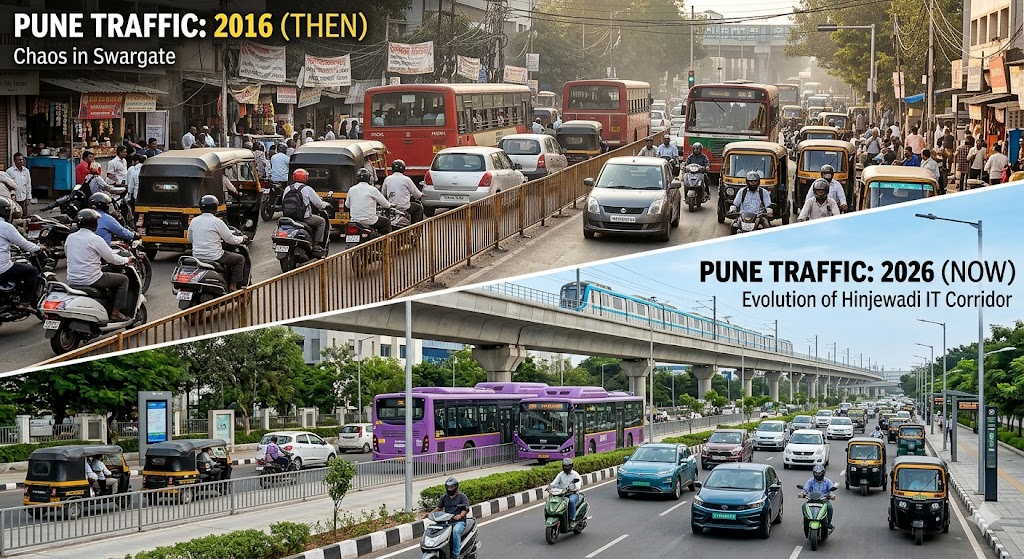
Pune Traffic: Then vs Now – Why Is Pune Facing So Much Traffic?
Pune, often called the Oxford of the East, has changed dramatically over the last decade. Once known for its peaceful roads, pleasant weather, and relaxed lifestyle, the city has now become one of the Top Traffic congested cities in india.
Today, thousands of people spend hours stuck in traffic every day. Whether you travel through Hinjawadi, Wakad, Baner, Kharadi, Hadapsar, Shivajinagar, or Swargate, traffic jams have become a part of daily life.
But how did Pune reach this stage?
Did the government take any steps to reduce traffic?
Are those projects helping?
What impact are these projects having on the environment?
Let’s understand everything in simple words.
Pune Traffic 10 Years Ago (Around 2015)
About ten years ago, Pune looked very different.
The city’s population was growing, but the number of vehicles was much lower than it is today. Most roads were less crowded, and travelling from one part of the city to another usually took much less time.
People preferred two-wheelers because they were affordable and convenient. Cars were increasing, but they had not yet reached today’s massive numbers.
IT companies in Hinjawadi, Magarpatta, Kharadi, and Pimpri-Chinchwad were already attracting professionals from across India. However, office campuses and residential areas were still developing, so traffic remained manageable.
Students from across the country came to Pune for education, but the city’s transport system could still handle most daily traffic.
Although traffic jams occurred near major junctions during office hours, they usually lasted only a short time.
For many residents, Pune was still considered one of the easiest metro cities to drive in.
Pune Traffic Today (2026)
Fast forward to today, and the situation has changed significantly.
Pune is now one of India’s fastest-growing cities. Every year, thousands of new residents move here for jobs, education, and business opportunities.
The city’s roads now carry millions of vehicles every day. Cars, motorcycles, buses, delivery vehicles, taxis, and heavy trucks compete for limited road space, especially during peak office hours. Rapid urban growth has placed enormous pressure on the transport network.
During the morning and evening rush hours, commuters often spend 30 minutes to over an hour covering distances that would normally take much less time.
Traffic congestion is especially common in:
- Hinjawadi IT Park
- Wakad
- Baner
- Balewadi
- Kharadi
- Hadapsar
- Swargate
- Shivajinagar
- Pune Railway Station
- Airport Road
- Viman Nagar
For many working professionals, losing two to three hours every day in traffic has become a normal part of life.
Why Has Pune’s Traffic Increased So Much?
Traffic problems do not happen because of just one reason. Many factors together have made the situation worse.
1. Rapid Population Growth
Pune’s population has grown rapidly and one of the top traffic congested city in india over the last decade.
People from different parts of India continue moving to the city for better education, IT jobs, startups, manufacturing, and healthcare.
More people naturally mean more vehicles on the roads.
2. IT Industry Growth
Hinjawadi, Kharadi, Magarpatta, Talawade, and other technology hubs have expanded quickly.
Thousands of employees travel to these offices every morning and return home in the evening, creating heavy congestion during peak hours.
3. Increase in Private Vehicles
Many families now own more than one vehicle.
Two-wheelers remain popular, while car ownership has also increased due to higher incomes and easier financing.
Every new vehicle adds pressure to roads that were never designed for today’s traffic volumes.
4. Limited Road Space
Unlike newer planned cities, many parts of Pune have older, narrower roads.
As the city expanded, several roads became too small to handle the growing number of vehicles.
Road widening is often difficult because buildings, shops, and public infrastructure already exist along these routes.
5. Construction Activities
Large infrastructure projects such as metro corridors, flyovers, bridges, and road improvements are necessary for the future, but during construction they temporarily reduce road space and slow traffic.
Many commuters experience delays near construction zones before these projects are completed.
What Has the Government Done to Reduce Traffic?
The Maharashtra Government, Pune Municipal Corporation (PMC), Pune Metropolitan Region Development Authority (PMRDA), and Maha Metro have launched several major projects to improve mobility.
Pune Metro
The Pune Metro is one of the city’s biggest transport projects.
Its main objective is to reduce dependence on private vehicles by providing a faster and more reliable public transport option. The metro network is expanding, including Line 3 connecting the IT hub of Hinjawadi with central Pune.
Benefits
- Faster travel
- Less traffic on major roads
- Reduced fuel consumption
- Lower air pollution
- Comfortable public transport
As more metro lines become operational, many daily commuters are expected to shift from private vehicles to public transport.
Pune Ring Road Project
One of the most important ongoing infrastructure projects is the Pune Ring Road.
The project is designed to allow vehicles travelling across the region to bypass the city centre instead of entering already congested roads.
The Ring Road aims to connect major highways, IT parks, industrial zones, the airport, and surrounding growth corridors while reducing congestion and improving regional connectivity. Land acquisition and construction are progressing in phases.
Expected Benefits
- Fewer heavy vehicles inside the city
- Better travel between suburbs
- Reduced traffic in central Pune
- Faster movement for emergency services
- Improved logistics for industries
Flyovers and Junction Improvements
The government is also building new flyovers, grade separators, bridges, and redesigned intersections at several busy locations.
These projects aim to reduce waiting time at traffic signals and improve the flow of vehicles, although some have raised environmental concerns because they involve cutting mature trees.
Traffic Situation 10 Years Ago
Pune was once known for its peaceful roads.
Traffic mainly occurred in central areas
Current Situation
Today, Pune has become one of India’s fastest-growing cities.
Reasons:
- IT companies.
- Educational institutions.
- Rapid population growth.
- Increase in personal vehicles.
Many roads experience traffic jams daily.
Government Solutions
Pune is one busiest and in the top 5 traffic congested cities in india, The government has introduced several projects like:
- Pune Metro.
- Road expansion.
- BRTS corridors.
- Traffic monitoring systems.
Environmental Issues
Some development projects required:
- Tree removal.
- Construction activities.
- Increased dust pollution.
4.New Delhi – The Capital’s Traffic Challenge
New Delhi is more than just the capital of India. It is the country’s political, cultural, and economic heart. it is one of the top 5 traffic congested cities in india. Every day, millions of people travel across the city for work, education, business, shopping, tourism, and healthcare. Because of this constant movement, traffic has become one of New Delhi’s biggest urban challenges.
If you have ever visited New Delhi during peak hours, you have probably seen long lines of vehicles, crowded intersections, and slow-moving traffic. While traffic congestion is common in many large cities around the world, New Delhi experiences it on a much larger scale because of its growing population, increasing number of vehicles, and rapid urban development.
But things were not always like this.
Ten years ago, traffic in New Delhi was busy, but it was generally easier to travel across the city. Today, with millions of additional vehicles on the roads and expanding residential areas, traffic has become a daily challenge for many residents.
In this article, we’ll explore how traffic has changed over the last decade, why congestion has increased, what the government is doing to improve the situation, and what the future may look like if both development and environmental protection are not balanced.
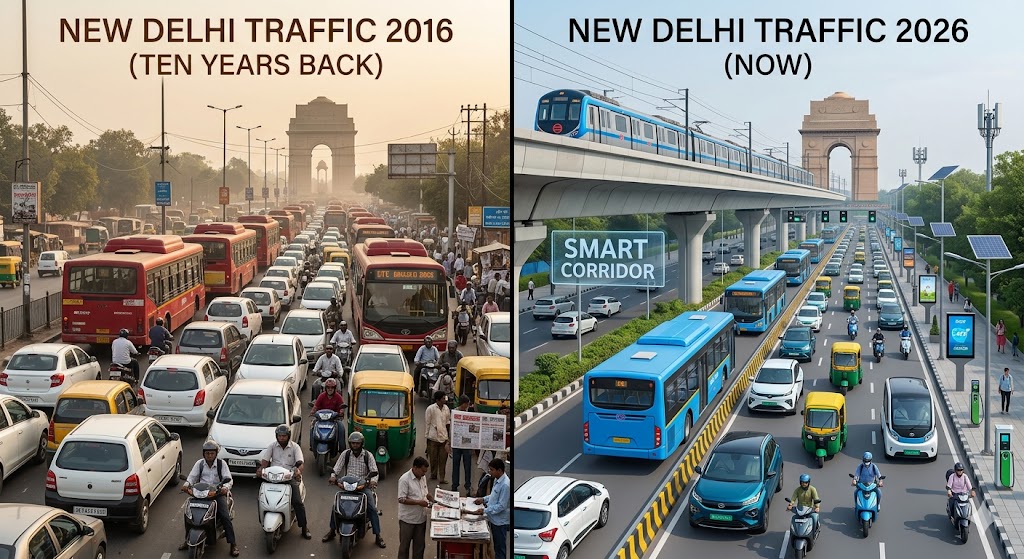
Traffic Situation 10 Years Ago
Around ten years ago, New Delhi already had a reputation for busy roads, but the situation was far less challenging than it is today.
Most major roads experienced heavy traffic mainly during morning and evening office hours. Outside these peak periods, many roads moved at a reasonable speed.
Several factors helped keep traffic relatively manageable:
Fewer private cars compared to today.
Ride-hailing services were still growing.
Online shopping deliveries were much lower.
The Delhi Metro was expanding rapidly, encouraging many people to choose public transport.
Commercial areas were less crowded than they are now.
Even though traffic jams were common in places like Connaught Place, ITO, Karol Bagh, and South Delhi, they usually cleared more quickly than they do today.
For many residents, travelling across the city still required patience, but long delays lasting several hours were less common.
Current Situation
Today’s New Delhi is a very different city.
The population has grown significantly, and the number of vehicles has increased year after year. Cars, motorcycles, buses, taxis, auto-rickshaws, delivery vehicles, and freight trucks all compete for space on the same roads.
Even with wider roads, new flyovers, and expanded metro lines, traffic congestion remains one of the city’s biggest challenges.
During peak hours, many commuters spend a considerable amount of time simply waiting in traffic. On busy days, even short journeys can take much longer than expected.
Construction projects, road repairs, weather conditions, festivals, and public events can make congestion even worse.
Why Has Traffic Increased So Much?
Traffic problems are rarely caused by just one reason. In New Delhi, several factors work together to create congestion.
1.Rapid Population Growth
Every year, thousands of people move to Delhi and nearby regions for better education, employment, and business opportunities. This could be one the reason one of the busiest city in india.
As the population grows, the demand for transportation also increases.
More people means:
More private vehicles
More public transport users
More commercial deliveries
Greater pressure on existing roads
2. Increase in Private Vehicles
Owning a car or motorcycle has become easier than before.
Improved incomes and easier financing have encouraged many families to own multiple vehicles.
While this provides convenience for individuals, it also means millions of additional vehicles are competing for limited road space.
3. Growth of Nearby Cities
Areas such as Gurugram, Noida, Ghaziabad, and Faridabad have developed into major business and residential hubs.
Every day, a huge number of people travel between these cities and New Delhi for work, creating heavy congestion on highways and connecting roads.
4. Commercial Deliveries
Online shopping has changed the way people buy products.
Thousands of delivery vans, trucks, and motorcycles now travel across the city every day to deliver food, groceries, medicines, and online orders.
While these services make life easier, they also add to road congestion.
5. Road Construction and Maintenance
New roads, bridges, flyovers, and metro projects are essential for a growing city.
However, construction work often narrows roads temporarily, creating traffic bottlenecks until projects are completed.
6. Festivals and Public Events
Delhi hosts many national celebrations, cultural events, political gatherings, and religious festivals throughout the year.
These events sometimes require road closures or traffic diversions, leading to temporary congestion.
7.Mixed Traffic on the Roads
One unique feature of Delhi traffic is the variety of vehicles sharing the same road.
At any moment, you may see:
Cars
Motorcycles
Buses
Auto-rickshaws
Cycle rickshaws
Trucks
Delivery bikes
Emergency vehicles
Managing so many different types of traffic safely is a major challenge.
Government Actions to Reduce Traffic in New Delhi
As one of the top Congested Cities in India, Traffic congestion has been one of New Delhi’s biggest challenges for many years. As the city’s population and the number of vehicles have grown, both the Central Government and the Delhi Government have introduced several projects and policies to improve traffic flow.
Some of these efforts have made daily travel easier, while others are still under development. Although no single solution can completely eliminate traffic, each project aims to make commuting faster, safer, and more efficient.
Let’s look at the major steps taken to reduce congestion in the capital.
1. Delhi Metro – The Backbone of Public Transport
When people talk about New Delhi’s biggest success in public transport, the first thing that comes to mind is the Delhi Metro.
Over the last decade, the metro network has expanded significantly, connecting residential neighborhoods, business districts, educational institutions, shopping centers, railway stations, and the airport.
Today, millions of passengers use the metro every day instead of driving their own vehicles.
How the Metro Helps Reduce Traffic
The metro offers several advantages:
Reduces the number of private cars on the roads.
Provides a faster and more predictable travel option.
Saves fuel and travel time.
Lowers traffic congestion in many busy areas.
Produces less pollution per passenger than many private vehicles.
Without the metro, Delhi’s roads would likely experience even greater congestion.
2. Construction of Flyovers and Underpasses
Another important strategy has been the construction of flyovers and underpasses.
Busy intersections often become traffic bottlenecks because vehicles from multiple directions must stop and wait.
Flyovers allow vehicles to cross intersections without stopping, while underpasses help separate traffic moving in different directions
Benefits
Faster movement at busy junctions.
Fewer traffic signals on major routes.
Reduced waiting time.
Improved traffic flow during peak hours.
However, as traffic continues to grow, even some flyovers become congested after a few years..
3. Expressways and Ring Roads
To reduce pressure on city roads, several expressways and ring-road projects have been developed or upgraded.
These roads help divert long-distance and commercial traffic away from crowded city centers.
Heavy trucks that once passed through busy urban roads can now use dedicated routes, helping reduce congestion in residential and commercial areas.
4. Smart Traffic Signals
Technology is now playing a bigger role in managing traffic.
Modern traffic signals can adjust signal timings based on the number of vehicles waiting at an intersection.
Instead of following a fixed timer, these systems respond to real-time traffic conditions.
Advantages
Shorter waiting times.
Better traffic flow.
Reduced fuel wastage.
Lower vehicle emissions caused by long idling.
Traffic cameras also help authorities monitor congestion and respond more quickly to incidents.
5. Better Public Bus Services
Buses continue to be an important part of Delhi’s transport system.
Over the years, authorities have introduced newer buses, improved routes, and increased the use of cleaner-fuel and electric buses.
A reliable bus network encourages people to choose public transport instead of using private vehicles.
When more people travel together in buses, fewer vehicles occupy the roads.
6. Promotion of Electric Vehicles
Electric vehicles (EVs) have become an important part of Delhi’s long-term transport strategy.
To encourage adoption, the government has introduced incentives, expanded charging infrastructure, and promoted electric buses and other public transport options.
Benefits of Electric Vehicles
Lower tailpipe emissions.
Reduced dependence on fossil fuels.
Quieter roads.
Improved air quality over time.
While EVs do not directly reduce the number of vehicles on the road, they can help reduce pollution associated with traffic.
7. Strict Traffic Rules and Digital Enforcement
Modern technology has also improved traffic law enforcement.
Many major roads are monitored using CCTV cameras.
Traffic violations such as speeding, jumping red lights, and dangerous driving can be detected automatically, making enforcement more consistent.
Digital systems have also made it easier for drivers to receive and pay fines.
These measures encourage safer driving and help improve traffic discipline.
Environmental Impact of Road Development
Large infrastructure projects often require land for construction.
Building wider roads, flyovers, tunnels, or new transport corridors may involve changes to existing landscapes.
In some cases, trees have been removed to make way for development projects. Such decisions are usually accompanied by environmental conditions, including compensatory tree planting and other mitigation measures.
This has led to public discussions about balancing urban development with environmental protection.
Why Trees Matter
Trees play an important role in city life.
They help to:
Reduce air pollution.
Provide shade.
Lower local temperatures.
Absorb carbon dioxide.
Support birds and other wildlife.
Improve the overall quality of urban life.
Losing mature trees can increase heat and reduce the environmental benefits they provide until new plantations grow.
Can Development and Nature Work Together?
Many experts believe that cities should not have to choose between development and environmental protection.
Instead, infrastructure projects can be planned in ways that reduce environmental damage.
Examples include:
- Protecting large, healthy trees wherever possible.
- Planting more trees than are removed.
- Creating urban forests.
- Building green corridors.
- Improving parks and public open spaces.
- Designing roads that consider both transport and ecology.
The goal is to create a city where people can travel efficiently while also enjoying cleaner air and greener surroundings.
The Future of Traffic in New Delhi: One of the Top Traffic-Congested Cities in India
New Delhi has changed a lot over the past decade. The city has grown rapidly, more people have moved here, businesses have expanded, and millions of new vehicles have been added to the roads. These changes have brought economic growth and better opportunities, but they have also made traffic one of the biggest challenges for the city.
The good news is that New Delhi is not standing still. New roads, metro lines, smart traffic systems, and better public transport are helping improve travel. However, solving traffic congestion completely will require long-term planning, cooperation between the government and citizens, and a balance between development and environmental protection.
What Could Happen in the Future?
If the number of vehicles continues to increase at the current pace, traffic congestion may become even more serious in the coming years.
People could experience:
Longer travel times.
Increased fuel consumption.
Higher transportation costs.
More stress during daily commutes.
Greater pressure on public infrastructure.
Increased air and noise pollution.
As Delhi continues to expand, nearby cities such as Gurugram, Noida, Ghaziabad, and Faridabad will also contribute to higher traffic volumes because many people travel between these cities every day.
Without proper planning, roads that seem wide today may become heavily congested in the future.
What If Development Continues Without Protecting the Environment?
Development is important for every growing city. New roads, bridges, metro lines, and public facilities improve people’s lives and support economic growth.
However, if development happens without considering the environment, cities may face new problems.
1.Rising Temperatures
Trees provide shade and help cool the surrounding area.
If too many trees are removed, roads and nearby neighborhoods can become hotter, especially during summer.
This is known as the Urban Heat Island Effect, where cities become warmer than surrounding rural areas because of concrete, asphalt, and fewer green spaces.
2.Poorer Air Quality
Trees naturally absorb carbon dioxide and help filter dust and pollutants from the air.
Fewer trees mean the city loses part of its natural ability to improve air quality.
When combined with heavy traffic, this can make pollution worse.
3.Increased Flooding
Green areas absorb rainwater.
When open spaces are replaced with concrete roads and buildings, rainwater has fewer places to soak into the ground.
This increases the risk of waterlogging and flooding during heavy rainfall.
4.Loss of Wildlife
Even in a busy city like Delhi, many birds, butterflies, squirrels, and small animals depend on trees and parks.
Removing green spaces reduces their habitat and affects urban biodiversity.
5.Kolkata Traffic: Then vs Now (2026) – How the City is Changing and What the Future Holds
Explore how, Kolkata is one of the most congested Cities in India, with increasing congestion over the past decade.. Learn about today’s traffic conditions, government initiatives, metro expansion, flyovers, environmental impact, and what the future may look like in this complete guide.
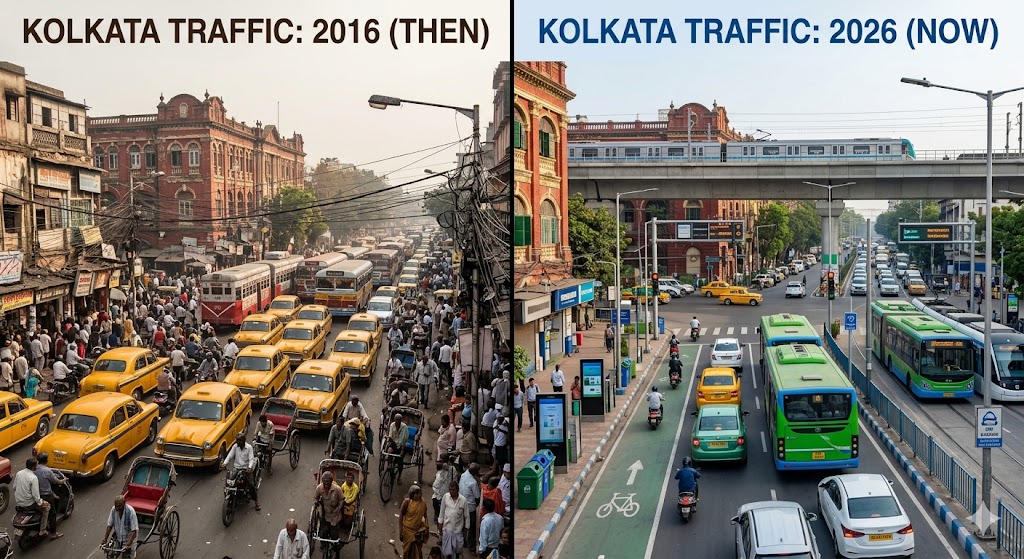
Kolkata Traffic: Then vs Now – How the City is Changing and What the Future Holds
Kolkata is one of India’s oldest, busiest, and most vibrant cities. Often called the “City of Joy,” it is famous for its colonial architecture, rich culture, yellow taxis, historic trams, and delicious street food. Every day, millions of people travel across the city to reach offices, schools, colleges, hospitals, markets, railway stations, airports, and tourist attractions.
Like every growing city, Kolkata has experienced a major increase in population and vehicles over the last decade. As more people moved to the city for jobs, education, and business, the roads became busier than ever before. Areas that once had smooth traffic now witness long queues of vehicles during peak hours.
Despite these challenges, Kolkata continues to perform better than many Indian metropolitan cities because of its strong public transport network. The city has buses, trams, suburban trains, ferries, auto-rickshaws, taxis, and an expanding metro rail system that helps reduce pressure on the roads.
The Government of West Bengal has also invested in metro expansion, new flyovers, improved road infrastructure, smart traffic management systems, and better traffic monitoring to improve mobility across the city. These efforts aim to make travel safer, faster, and more comfortable for everyone.
In this article, we’ll explore how Kolkata’s traffic has changed over the past 10 years, what causes congestion today, and how the government is working to build a better transport system for the future.
Kolkata Traffic 10 Years Ago: A City That Moved at a Slower Pace
Around 2015, Kolkata is most Congested City in India, but it was not as intense as it is today. During office hours, roads became crowded, especially in commercial areas, but many neighborhoods still enjoyed relatively smooth traffic for most of the day.
Back then, people depended heavily on public transport. Government buses, private buses, trams, local trains, and the Kolkata Metro were the preferred choice for daily travel. Private vehicle ownership was growing, but it had not reached today’s levels.
The city’s roads carried a healthy mix of public transport, commercial vehicles, taxis, and personal vehicles. Although delays occurred during peak hours, journeys were generally shorter, and commuters spent less time waiting at traffic signals.
Why Traffic Was Easier to Manage
There were several reasons why Kolkata’s traffic remained relatively controlled.
Strong Public Transport
A large percentage of residents preferred buses, local trains, and metro services instead of private cars. This reduced the number of vehicles on the roads.
Lower Car Ownership
Many middle-class families relied on public transport because buying and maintaining a car was expensive.
Fewer Delivery Vehicles
Online shopping was still developing. There were fewer food delivery bikes, courier vans, and e-commerce vehicles compared to today.
Limited IT Expansion
Although Salt Lake Sector V was already an important IT hub, it was much smaller than it is today. Daily commuter numbers were lower.
Kolkata Traffic Today (2026): A Much Busier City
Fast forward to today, and Kolkata looks very different.
The city’s population has grown steadily. New residential apartments, shopping malls, office buildings, hospitals, educational institutions, and commercial complexes have appeared across different parts of the city.
At the same time, the number of vehicles has increased dramatically.
Every morning, thousands of people leave their homes for work, school, and business. Roads become crowded with buses, motorcycles, cars, taxis, app-based cabs, delivery vehicles, trucks, and auto-rickshaws.
Although Kolkata still has one of India’s strongest public transport systems, the growing number of private vehicles has created additional pressure on roads that were originally designed decades ago.
Government Efforts to Reduce Traffic
The Government of West Bengal has introduced several important initiatives to improve traffic movement across Kolkata.
These include:
Expanding the Kolkata Metro Network
The metro network is being expanded to connect more parts of the city, reducing dependence on private vehicles.
Building New Flyovers
Flyovers help traffic move without stopping at busy intersections, reducing waiting times.
Smart Traffic Signals
Modern traffic signals adjust timing based on the number of vehicles at an intersection, helping
CCTV Monitoring
Hundreds of CCTV cameras help traffic police monitor congestion, detect accidents quickly, and respond faster to emergencies.
Government Projects Making a Difference
Reducing traffic in a city as large and busy as Kolkata is not an easy task. It cannot be solved by building just one flyover or widening one road. The government has to improve roads, public transport, traffic management, and urban planning together. Over the last few years, several important projects have been introduced to make travelling easier for millions of people.
Kolkata Metro Expansion – The Biggest Step Towards Better Traffic
The Kolkata Metro is one of the city’s greatest strengths. It was India’s first metro railway and has been serving passengers for decades. However, as the city expanded, one metro line was no longer enough.
To meet the growing demand, new metro corridors have been developed to connect more residential areas, business districts, railway stations, and the airport.
How Metro Expansion Helps
Every metro train can carry hundreds of passengers at one time. If these passengers travelled by cars or motorcycles instead, the roads would become much more crowded.
Construction of Flyovers
Another major effort to reduce traffic has been the construction of flyovers across busy intersections.
Instead of stopping at multiple traffic signals, vehicles can move continuously over the flyover while local traffic remains below.
Benefits of Flyovers
Flyovers help in several ways:
Reduce waiting time at traffic signals.
Improve traffic flow during peak hours.
Save fuel by reducing long vehicle queues.
Help emergency vehicles move faster.
Reduce congestion at important road junctions.
Although flyovers cannot solve every traffic problem, they have improved travel in many parts of
Smart Traffic Management System
Traffic management today is very different from what it was ten years ago.
Instead of depending only on manual traffic control, Kolkata Traffic Police now use modern technology to manage vehicle movement more efficiently.
Has Development Harmed the Environment?
This is one of the most important questions people ask today.
Whenever governments build wider roads, flyovers, metro stations, or commercial buildings, some environmental impact is unavoidable.
Tree Cutting
In some projects, trees have been removed to create space for construction.
Trees provide:
Shade
Fresh air
Lower temperatures
Better air quality
Habitat for birds
When trees disappear, cities become hotter and less comfortable.
For this reason, environmental experts often recommend planting several new trees for every tree removed.
Air Pollution
Traffic congestion increases pollution because vehicles spend more time standing with their engines running.
This releases harmful gases into the air.
These include:
Carbon dioxide
Carbon monoxide
Nitrogen oxides
Fine dust particles
These pollutants affect both the environment and human health.
Children and elderly people are especially vulnerable to polluted air.
Noise Pollution
Constant vehicle movement also creates noise pollution.
Common sources include:
- Vehicle horns
- Heavy trucks
- Construction equipment
- Motorcycles
- Emergency vehicle sirens
High noise levels can lead to stress, headaches, and disturbed sleep for people living near busy roads.
What Could Happen in the Future?
If the number of vehicles continues to grow faster than road capacity, Kolkata could face more serious traffic challenges in the coming years.
Possible future problems include:
Longer Travel Times
A journey that takes 30 minutes today could take an hour or more if congestion keeps increasing.
Higher Fuel Costs
Vehicles stuck in traffic consume more fuel, increasing transportation expenses for families and businesses.
Increased Air Pollution
More vehicles mean more emissions unless cleaner transport options become widely adopted.
Rising Temperatures
If urban development continues without protecting green spaces, Kolkata may experience stronger heat island effects, making summers even hotter.
Health Problems
Air pollution and long commuting hours can contribute to breathing disorders, stress, fatigue, and reduced quality of life.
What More Can Be Done?
Although the government has taken important steps, solving traffic problems requires cooperation from everyone.
Government Can
Expand metro services further.
Increase electric bus fleets.
Build more cycling tracks.
Improve footpaths.
Develop additional parking facilities.
Encourage transit-oriented urban planning.
Protect existing green spaces.
Plant more trees during development projects.
Citizens Can
People also play an important role.
Simple actions include:
Using public transport whenever possible.
Carpooling with colleagues.
Avoiding unnecessary car trips.
Following traffic rules.
Not parking illegally.
Respecting pedestrian crossings.
Avoiding unnecessary honking.
Small daily habits can make a big difference.
Is Kolkata’s Traffic Better Than Other Metro Cities?
Compared with cities such as Bengaluru, Mumbai, Delhi, and Pune, Kolkata often benefits from its extensive public transport network.
The metro, suburban railways, buses, ferries, and trams provide multiple travel choices, helping reduce dependence on private vehicles.
However, congestion remains a challenge in busy commercial areas, railway station surroundings, shopping districts, and IT hubs.
As the city continues to grow, improving public transport and managing vehicle numbers will remain essential.
Comparison Table
| City | Traffic 10 Years Ago | Current Situation | Major Government Actions |
|---|---|---|---|
| Bengaluru | Moderate | Very High | Metro, flyovers |
| Mumbai | High | Very High | Metro, coastal road |
| Pune | Low to Moderate | High | Metro, BRTS |
| New Delhi | High | Very High | Metro, Odd-Even |
| Kolkata | Moderate | High | Metro, flyovers |
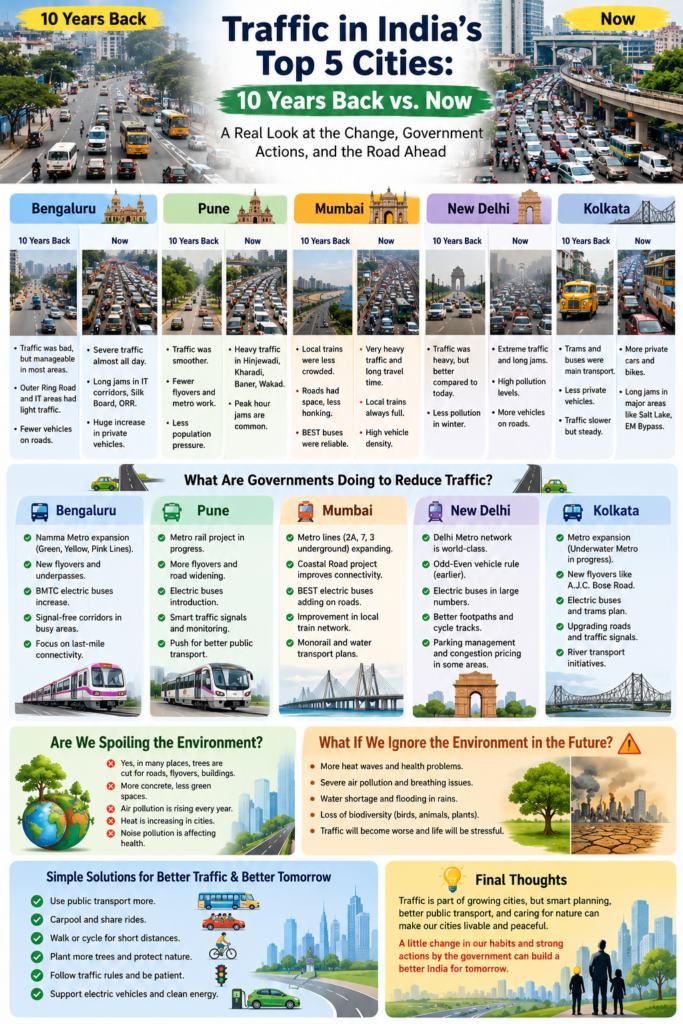
Final Thoughts
Traffic is not only a road problem. It affects health, the environment, fuel consumption, and quality of life.
Bengaluru, Mumbai, Pune, New Delhi, and Kolkata have all experienced major changes over the last decade. Governments are investing in infrastructure, metro systems, and smart transportation, but protecting the environment remains equally important.
The future of Indian cities depends on finding a balance between development and nature. Better roads are important, but cleaner air, green spaces, and sustainable transport are equally necessary.
If governments, citizens, and city planners work together, Indian cities can become faster, cleaner, and more comfortable places to live.